Paid Telegram and WhatsApp Channel Mistakes SEBI RAs MakeThe paid Telegram and WhatsApp channel mistakes SEBI research analysts make most easily come down to order and evidence: adding members before KYC, consent and payment, collecting fees the wrong way, posting claims SEBI prohibits, and treating chat history as the record. Here are ten mistakes and how to avoid each one. 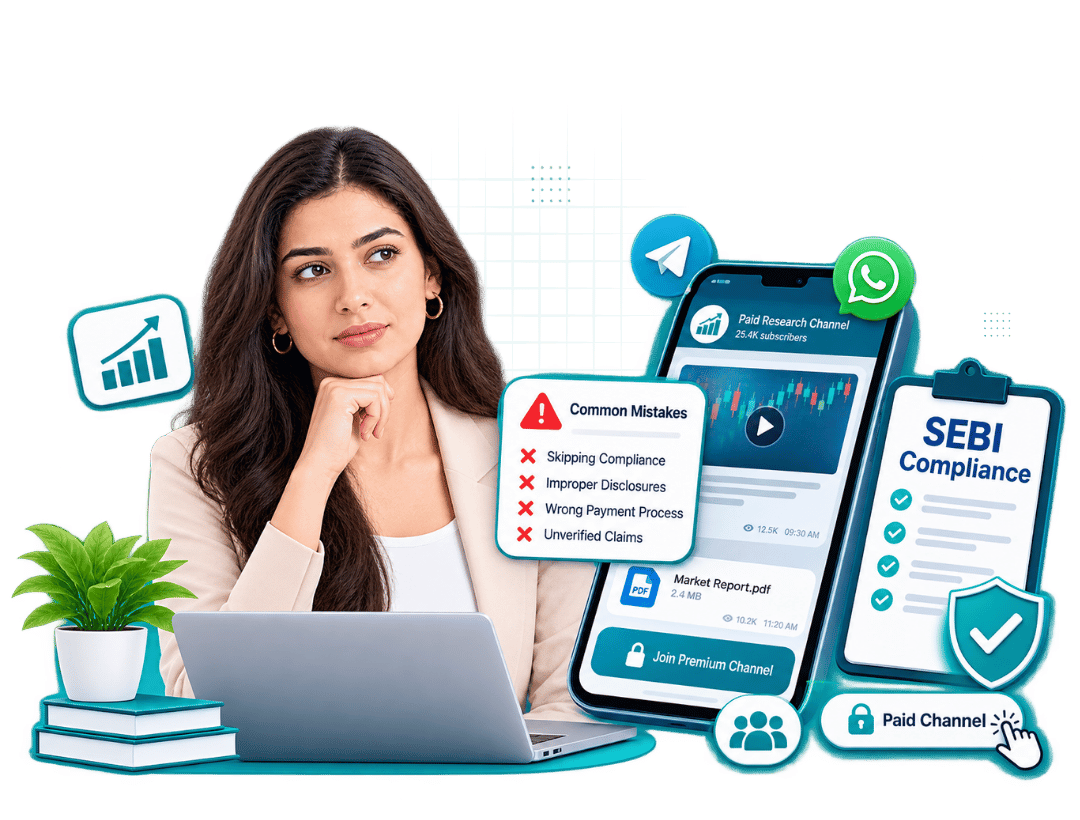 Last updated: 21 October 2026 The paid Telegram and WhatsApp channel mistakes SEBI research analysts (RAs) make most easily are about order and evidence. They let people into the group before KYC, consent and payment, collect fees through the wrong channels, post claims SEBI prohibits, and rely on the chat app as their only record. Each one is avoidable once you treat every paying member as a client with full rights under the SEBI (Research Analysts) Regulations, 2014. A tool for running paid Telegram and WhatsApp channels for SEBI RAs helps by sending group invites only after payment. Below are ten mistakes, the rule behind each and how to avoid it, based mainly on the Master Circular for Research Analysts dated 6 February 2026. This is not legal advice: check the current SEBI regulations, circulars and RAASB guidance before you change how your channel runs. 1. Charging for a channel before you are registeredA free channel slowly turns paid when a UPI link appears in the pinned message. Charging for buy, sell or hold calls on securities is a research service, and the RA Regulations cover anyone who provides research services for consideration. They make no exception for Telegram, WhatsApp or other messaging apps. Register with SEBI as an RA through RAASB (currently BSE) before you take a single payment. Even a free channel run by a registered RA is public media, so Regulation 21 requires you to disclose your registration status and any financial interest in a company you discuss. Our guide to becoming a SEBI research analyst covers the route. 2. Adding members before KYC, consent and paymentA prospect sends a payment screenshot, is added straight away, and the paperwork waits. Para 1.12(b) of the master circular says no research service may be rendered and no fee charged until the client has consented to your terms and conditions, including the Most Important Terms and Conditions (MITC). Regulation 25(1) and para 1.13(a) also require KYC for fee-paying clients. A Telegram username or a phone number is not KYC. Fix the order and do not skip steps: KYC with PAN and KRA checks, then disclosure of your terms and MITC with consent (Aadhaar-based e-sign is one accepted mode), then payment, and only then the invite. Finuro's e-KYC and onboarding runs these steps in a set sequence per product before payment. Our post on client KYC and KRA onboarding explains step one in detail. 3. Collecting fees into a personal UPI ID or in cashSmall channels often start with fees sent to a personal UPI ID, or cash. The MITC says fees may be paid by modes such as cheque, online bank transfer or UPI, and cash is not allowed. SEBI's circular of 11 June 2025 requires registered intermediaries, including RAs, to collect UPI payments through validated UPI IDs with the @valid handle. Collect only through permitted channels, issue an invoice for every payment and keep the trail. The MITC does not name payment gateways, so confirm your gateway set-up with your compliance adviser. Finuro's subscription billing works with Razorpay, Cashfree and HDFC and issues GST invoices. 4. Selling "lifetime" or open-ended memberships"Pay once, stay forever" offers are common in unregistered tip groups, and some registered channels copy them. For individual and HUF clients who are not accredited investors, the master circular caps fees at ₹1,51,000 per family per year across all your research services, allows advance fees only if the client agrees, and requires a proportionate refund of the unexpired period with no breakage fee if the service ends early. The advance limit itself needs care: para 1.9(f) allows up to one year, while the MITC text still says "presently it is one quarter". A lifetime plan fits none of these rules. Sell plans with a fixed period, write the refund method into your terms and confirm the current advance-fee position before selling long plans. See our guide to RA fee limits and payment rules. 5. Letting expired members stay in the groupLapsed members often stay for weeks because removing them is tedious. Research then reaches people who are no longer clients, and your client register no longer matches who receives it. Regulation 25 requires a client register with the date and nature of the service and the fee charged, so access should match it. Keep a list of expiry dates, remove access when a plan ends and record when you did it. Finuro's billing tracks each subscription through pauses, extensions and cancellations, so you can see whose access should end. 6. Leaving out identity details and disclaimersA channel called "Smart Trader Calls" with no registered name, registration number or website link leaves members unsure who is behind it. Section 11.2 of the master circular requires your registered name, logo, registration number and address to be displayed prominently on your website, advertisements and client documents, and client correspondence must show your compliance and grievance officer details. SEBI's FAQs add that you must use the term "research analyst" in correspondence with clients. Put your registered name, registration number, the term "research analyst" and your website link in the channel description and pinned message, and add the required disclosures and disclaimer to each recommendation. This mapping to Telegram and WhatsApp features is a practical reading; SEBI does not name the apps. Our research report disclosures checklist lists what each call must say. 7. Treating the chat history as your recordThe app is not a dependable archive. WhatsApp said at launch that it keeps Channel history on its servers for up to 30 days, and a message deleted in a Telegram channel disappears for every subscriber. Para 1.13 of the master circular requires records of interactions with clients and prospective clients from the first interaction, kept for five years, and longer if a dispute is raised. Regulation 25(2) sets the same five-year minimum for your other records. Keep your own dated copy of every recommendation and message, outside the chat app, with the time and the recipients. Finuro delivers recommendations by email, WhatsApp and Telegram with delivery logs, and its communication records keep what you sent in one place. 8. Posting profit screenshots and accuracy claims in teaser channelsFree "teaser" channels that push people to the paid one often show screenshots of winning calls or lines like "90% accuracy last month". Those posts promote your service, so they are advertisements under section 11 of the master circular. The code bars any implication of assured returns or percentage accuracy, and any past performance not verified by a Past Risk and Return Verification Agency (PaRRVA) and shown as SEBI specifies. Advertisements also need prior approval from RAASB. SEBI recognised CARE Ratings as a PaRRVA, with regular services from 4 May 2026. From around April 2027, the common advertisement code in the SEBI (Intermediaries) (Second Amendment) Regulations, 2026 also says research shared with existing clients is not an advertisement only if it contains no performance claims, and it bans testimonials in advertisements. Keep performance claims out of every channel. Our guide to the SEBI advertisement code for RAs covers the details. 9. Paying unregistered tip channels to promote yoursPaid shout-outs and cross-promotion swaps with bigger tip channels look like cheap growth. Since August 2024, Regulation 16A of the SEBI (Intermediaries) Regulations bars regulated entities from any direct or indirect association with persons who give securities advice without registration or make unpermitted performance claims. SEBI's FAQs say association includes payments, referral of clients and sharing client information. Before you pay or swap with anyone, check whether they give stock recommendations without registration or make performance claims, and keep a note of the check. Our post on SEBI's finfluencer rules explains what counts as association. 10. Running open groups without moderationIn open groups, members post their own stock ideas, which new clients may read as your research. Several groups for one plan can also mean some clients get a call before others. The investor charter in the master circular lists distributing research reports and recommendations to clients without discrimination as one of an RA's services. Use a read-only channel or admin-only posting for research, keep any discussion group moderated, and send each recommendation to every client on a plan at the same time. Our comparison of WhatsApp and Telegram for advisory delivery covers the admin controls each app offers. A checklist before your next channel launch
Finuro lets you attach one or several Telegram or WhatsApp groups to a plan, send invites only after payment, and deliver recommendations with disclaimers and delivery logs. See how Finuro's paid Telegram and WhatsApp channels work, and read our full guide to SEBI rules for paid Telegram channels. Related Finuro features
Frequently asked questionsAnswers to common questions on this topic. Built for SEBI RAs and IAs Run your paid channel in the right orderAttach Telegram or WhatsApp groups to plans and send invites only after KYC, consent and payment.  |

Book a Demo
See how Finuro handles onboarding, recommendations, model portfolios, and billing for your advisory firm. Tell us a little about your practice and we'll walk you through the platform on a live call.