12 Compliance Mistakes SEBI Research Analysts Make (and How to Avoid Them)The most common SEBI research analyst compliance mistakes are charging fees before consent, weak KYC, breaching fee limits, using the wrong payment channels, unverified performance claims, calls without disclosures and missing records of sales conversations. Each one breaks a specific SEBI rule, and each can be avoided with a clear process and records kept in one place. 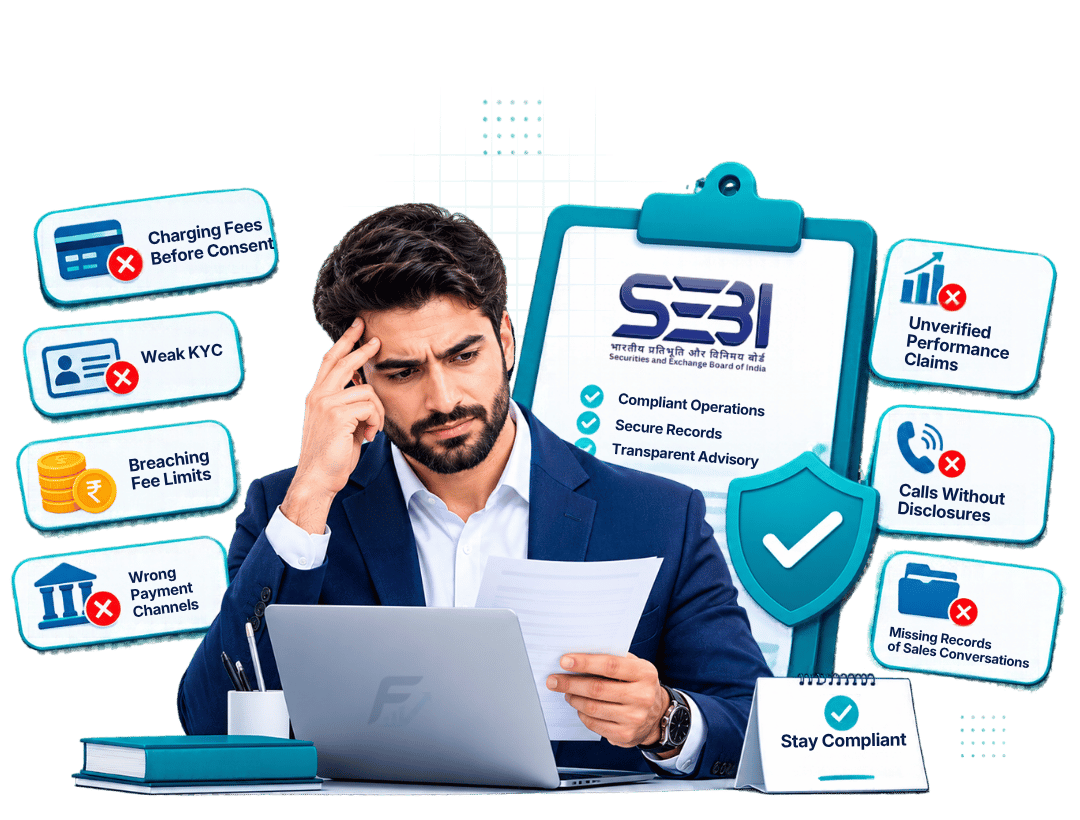 Last updated: 21 October 2026 The most common SEBI research analyst compliance mistakes are easy to make and just as easy to avoid: charging fees before the client consents to your terms, skipping KYC, going over the fee limit, collecting money through the wrong channels, advertising unverified performance, sending calls without disclosures or a rationale, and losing the records of sales conversations. Each one breaks a specific rule in the SEBI (Research Analysts) Regulations, 2014 or the RA master circular. Most come down to client data kept in too many places, which is why a CRM built for SEBI research analysts is often the first fix. This guide lists 12 mistakes, the rule or risk behind each one, and how to avoid it. It is based on the RA Regulations as amended up to 10 October 2026 and the Master Circular for Research Analysts dated 6 February 2026, with later circulars noted where they change things. It is a summary, not legal advice. Check the current SEBI rules and RAASB instructions, and speak to your compliance adviser, before acting on it. The 12 mistakes at a glance1. Charging fees or starting the service before the client consentsThis is one of the easiest mistakes to make when you sell through payment links. A new subscriber pays, is added to the channel and starts receiving calls, and the terms are emailed "later". Or an existing client renews on the old terms because nobody sent the updated version. Regulation 24(6) requires you to disclose your terms and conditions to the client and take their consent in the manner SEBI specifies. Para 1.12(b) of the master circular is blunt: no research service may be rendered and no fee charged until consent is received. The terms must include the Most Important Terms and Conditions (MITC), and Annexure B sets the minimum mandatory terms. Consent can be signed in person or through any other legally acceptable mode, including DigiLocker-enabled Aadhaar e-sign. For existing clients, consent is due on or before the renewal date or the next fee due date, whichever is earlier. To avoid it, make consent a step that must be completed before the payment page opens, and keep the signed copy with its date and time. Finuro's onboarding sequence can be set per product (KYC, then MITC, then risk assessment, then payment) with Aadhaar e-sign through Digio or Cashfree, or email OTP e-sign; see e-KYC and client onboarding. 2. Treating KYC as a formalityIn practice this looks like PAN numbers collected over WhatsApp, KYC done only for larger clients, or documents saved in a shared drive with no KRA check. When an auditor samples ten clients, three have nothing on file. Regulation 25(1)(v) requires KYC records of every fee-paying client, and para 1.13(a) of the master circular says RAs must follow the KYC procedure SEBI specifies. That procedure runs through KYC Registration Agencies under SEBI's KYC master circular of 12 October 2023. Regulation 25(1)(vi) also requires a client register with each client's PAN, the date and nature of the service, the securities covered and the fee received. To avoid it, check every fee-paying client with a KRA before the first call, store the KYC with the client record rather than in email, and make sure the client register is built from the same data. Finuro runs KYC checks with CVL KRA and NDML KRA and can fetch PAN details and KYC documents. Our guide to client KYC and KRA onboarding covers the steps. 3. Going over the fee limit or taking too much in advanceThe fee mistakes are usually accidental. Two members of the same family subscribe separately and together pay more than the limit. A "two-year plan" is sold at a discount. A client who cancels early is told there are no refunds. Para 1.9 of the master circular caps fees at ₹1,51,000 per annum per family for individual and HUF clients, excluding statutory charges. RAASB revises the limit once every three years based on the Cost Inflation Index after consulting SEBI. The fee provisions (limit, payment modes, refunds, advance fees, breakage fees) apply to individual and HUF clients who are not accredited investors; other clients are governed by negotiated terms. If the client agrees, you may charge in advance, but para 1.9(f) says the advance must not exceed fees for one year. On early termination, the client is refunded proportionate fees for the unexpired period and no breakage fee may be charged. One point is unsettled: the MITC text in Annexure B of the same master circular still says the advance period is "presently" one quarter. Until SEBI or RAASB aligns the two, confirm the period you use with your compliance adviser and RAASB. To avoid the rest, track fees per family using PAN, limit plan lengths, and write the refund calculation into your terms. Finuro's subscription billing handles plans, pauses, extensions and cancellations, but it does not enforce the family limit; you set the prices and plan lengths. See RA fee limits and payment rules for worked examples. 4. Collecting fees through the wrong channelsThis covers cash, payments into a staff member's personal UPI ID, payments to a related company that is not the registered RA, and old UPI IDs that were never moved to the validated format. The MITC says fees may be paid through cheque, online bank transfer, UPI and similar banking channels, that cash is not allowed, and that the Centralised Fee Collection Mechanism (CeFCoM) is optional. SEBI's circular of 11 June 2025 requires registered intermediaries, including research analysts, to collect payments from investors through validated UPI IDs with the "@valid" handle. The MITC does not name card payments or payment gateways, so confirm with your compliance adviser how gateway collections fit your set-up. Paying or receiving money from an unregistered person engaged in prohibited activities can also count as "association" (see mistake 8). To avoid it, collect only into the registered entity's accounts, set up your @valid UPI ID, issue a receipt or invoice for every payment, and never accept cash. Finuro billing runs through Razorpay, Cashfree or HDFC with GST invoices; it does not decide whether a payment channel meets SEBI's rules for you. 5. Advertising past performance, accuracy or "best" claimsTypical examples: "90% accuracy last quarter", screenshots of profitable trades, "India's No. 1 analyst", a "free" trial that needs card details, or a wall of client testimonials. The advertisement code in para 11.1 of the master circular bans references to past performance or risk-return metrics unless they are verified by the Past Risk and Return Verification Agency (PaRRVA) and claims are made in the manner SEBI specifies. It also bans any implication of assured or minimum returns or percentage accuracy, superlatives such as "Best" or "No. 1", calling anything "free" unless it really is free without condition, and misleading testimonials. Adverts need prior approval from RAASB, and copies must be kept for five years. SEBI's circular of 29 April 2026 confirmed CARE Ratings as the PaRRVA, with regular services from 4 May 2026. Certified pre-PaRRVA performance may only be shared one-to-one with a client who asks for it, under section 23 of the master circular. A bigger change is coming. The SEBI (Intermediaries) (Second Amendment) Regulations, 2026 add a common advertisement code that takes effect on the 180th day after Gazette publication, around early April 2027. It bans testimonials in adverts (Regulation 16O(a)) and bars incentives, vouchers, coupons or subscription plans offered to induce clients to take a service (Regulation 16L(1)(g)). Review your offers, coupons and testimonial pages before then. Finuro's performance analytics are for your own review; Finuro is not a PaRRVA and does not verify figures for advertising. See the SEBI advertisement code for RAs and PaRRVA explained. 6. Sending calls without disclosures or a real rationaleA WhatsApp message saying "Buy XYZ above 520, target 560, SL 500" with no disclosures, sent to a paid group, and a rationale that is a chart screenshot saved on someone's phone. It is an easy mistake because the message feels too short to count as research. It does count. Regulation 2(1)(w) defines a research report as any written or electronic communication that includes a research recommendation or opinion on securities and provides a basis for an investment decision, and SEBI's FAQs confirm that recommendations on a security using technical analysis are covered. Regulation 19 requires disclosures about financial interest, holdings of 1% or more, other material conflicts and compensation, and Regulation 19(vii) requires you to disclose the extent of your use of AI tools. Regulation 18(7) requires an adequate documentary basis, supported by research, and Regulation 20(4) requires recommendations to be corroborated by relevant data and analysis. Regulation 25(1) requires you to keep both the recommendation and its rationale. Para 11.2 of the master circular adds your registered name, registration number, contact details and the SEBI disclaimer to reports and client correspondence. To avoid it, write the rationale before the call goes out and keep a standard short disclosure for messages with a link to your full disclosures. Finuro stores each call with horizon, entry range, targets, stop-loss and status, supports AI-assisted rationale and disclaimers on messages and reports, and keeps delivery logs; see recommendation records and our research report disclosures checklist. 7. Leaving lead and sales conversations out of your recordsLead management is where record keeping most often breaks down. Telecallers phone leads from ad forms on their own mobiles, prospects chat with sales staff on personal WhatsApp, and nothing is linked to the person once they become a client. When that client later complains about what they were promised, there is no record of the conversation. Para 1.13(b) of the master circular requires records of interactions with all clients, including prospective clients before onboarding, wherever a conversation about your services has taken place. Accepted forms are a physical record signed by the client, telephone recordings, email from the registered email ID, SMS records or any other legally verifiable record. The records begin at the first interaction, continue until the service ends and must be kept for five years, or longer if there is a dispute or SEBI asks. From 9 November 2026, the RA (Amendment) Regulations, 2026 make call recordings with institutional investors optional, but nothing changes for retail prospects. Where your leads come from matters too: SEBI's FAQs on association say that lead generation through a marketing agency is a violation if you end up indirectly associated with someone engaged in prohibited activities. To avoid it, give every lead a record from the first contact, log calls and chats against it, and keep the history when the lead converts. Finuro's CRM handles lead import, segments, message templates and a unified inbox for email, WhatsApp and Telegram; it has no dialer, so call recordings come from your telephony provider. For telecalling, lead forms and lead funnels, Finuro works with FAB Builder CRM, available as a separate subscription. Whichever tools your sales team uses, make sure every conversation with a prospect ends up in a record you can produce for five years. 8. Working with unregistered tipsters, finfluencers or affiliatesPaying a Telegram admin who posts stock tips to promote your plan, running a referral deal with a YouTuber who shows their own trading profits, or sharing a lead list with an unregistered "partner" are all easy ways to get this wrong. Regulation 16A of the SEBI (Intermediaries) Regulations, 2008, and SEBI's circular of 29 January 2025 (updated 8 May 2026), bar registered intermediaries and their agents from any direct or indirect association with a person who gives advice or recommendations on securities without being registered or permitted, or who makes claims of returns or performance without SEBI's permission. "Association" includes any transaction involving money, referral of a client, interaction of IT systems or anything similar, and SEBI's FAQs say sharing client information counts. You can still use marketing partners, as long as they are not engaged in either prohibited activity. The FAQs list possible actions including penalty, suspension or cancellation of registration and debarment. To avoid it, check every promoter, affiliate, agency and channel admin before paying them, put the restriction in your contracts, and re-check their content from time to time. Our guide to SEBI finfluencer rules explains the prohibited activities in more detail. 9. Handling complaints slowly and skipping the monthly complaint dataA complaint arrives by email, sits in an inbox for weeks, and the website's complaint table has not been updated since spring. Regulation 26B requires you to redress investor grievances promptly and within 21 calendar days of receipt. The minimum MITC terms in Annexure B refer to 7 business working days, so the two documents use different timelines; working to the shorter one is the safer course, but confirm the position with your compliance adviser. Para 7.3 of the master circular requires you to publish complaint data on your website by the 7th of the following month in the Annexure E format, and para 7.1 requires you to bring the Investor Charter to clients' notice. Unresolved complaints can go to SEBI's SCORES platform and then to online dispute resolution through SMART ODR. To avoid it, keep a complaint register with the date received, the date resolved and the channel, review open items weekly, and update the website table every month. Finuro's unified inbox keeps email, WhatsApp and Telegram conversations in one place, which makes complaints easier to spot and trace; it does not connect to SCORES. See handling complaints through SCORES and ODR. 10. Forgetting the recurring filingsThe deposit is set once at registration and never revisited, the half-yearly report is filed late, or the SaaS undertaking is forgotten entirely. Para 1.2 of the master circular bases your deposit on the maximum number of clients on any day of the previous financial year: ₹1 lakh up to 150 clients, ₹2 lakh for 151 to 300, ₹5 lakh for 301 to 1,000 and ₹10 lakh above that, held as liquid or overnight mutual fund units or a scheduled bank deposit with a lien in favour of RAASB. If your slab changes, revise it by 30 April. SEBI's FAQs say non-fee-paying clients who get research as a value-added service count towards this number. Section 29 requires a periodic report to RAASB for the half-years ending 30 September and 31 March, within 30 days of each, and section 30 requires a half-yearly undertaking on SEBI's SaaS advisory. To avoid it, keep a compliance calendar with owners and dates, and reconcile your client count before each report. Finuro's business analytics show client numbers and renewals, which helps with the count; Finuro does not file anything with RAASB. Our monthly compliance checklist and RAASB filings guide list the dates. 11. Leaving the annual audit to the last week of OctoberIt is easy to treat 31 October as the audit deadline and start in September. The auditor then finds consents dated after payments, missing segregation certificates and no published audit status from last year. Regulation 25(3) requires an annual compliance audit by a member of ICAI, ICSI or ICMAI. SEBI's circular of 25 March 2026 replaced para 31 of the master circular to confirm that cost accountants may conduct it. Under para 1.14, the audit must be completed within six months of the financial year end, and the report submitted to RAASB or SEBI within one month of the audit report date, no later than 31 October. Adverse findings go in with the action taken, approved by the RA or its management. The annual client-level segregation certificate forms part of the audit, the audit must cover model portfolio compliance if you offer them, and you must publish the audit status and any adverse findings on your website and give the report to clients. To avoid it, collect evidence each month, book the auditor early in the year, and treat last year's adverse findings as this year's first check. Finuro's audit trail records every create, update and delete with the user and time, and you can bulk download a month of KYC and MITC e-sign documents. See the annual compliance audit guide. 12. Ignoring the rules that apply to your peopleA sales executive joins without NISM certification, a research analyst's certificate lapses unnoticed, or a team member's relative trades a stock just before the call goes out. Regulation 24(5) makes you responsible for making sure employees and partners meet the certification and qualification requirements of Regulation 7 at all times. SEBI's circular of 11 March 2026 lets persons associated with research services who only do sales and other non-core work take the lighter NISM Series XXV-A certification, while others continue with NISM Series XV. Regulation 16(2) bars independent and part-time research analysts, employed research analysts and their associates from trading in securities they recommend or follow from 30 days before to 5 days after a research report is published, and Regulation 16(3) bars trading against your own recommendation. To avoid it, keep a register of every certificate with its expiry date, and a personal trading declaration and log for everyone covered. Finuro's team roles and permissions let you limit who can publish recommendations or see client data. Our NISM Series XV guide covers certification. A quick compliance checklist for research analystsRun through this list each month. If you can answer yes to every item and show the evidence, you have avoided the mistakes above.
Most of these checks are faster when clients, consents, calls and conversations live in one system. See how Finuro's CRM for research analysts keeps them together. Related Finuro features
Frequently asked questionsAnswers to common questions on this topic. Built for SEBI RAs and IAs Keep your RA compliance records in one placeRun KYC, consent, calls, conversations and audit trails for your research service from one system.  |

Book a Demo
See how Finuro handles onboarding, recommendations, model portfolios, and billing for your advisory firm. Tell us a little about your practice and we'll walk you through the platform on a live call.